
What are Hate Crimes and Hate Incidents?
A Hate Crime is defined as a criminal offence that is motivated by prejudice, discrimination, and hostility towards an individual’s identity or perceived identity.
These can include disability, gender identity, race, sexual orientation, religion, or any perceived difference.
Hate Crimes are very personal crimes, which can make anyone feel unwelcome. It reinforces long-established patterns of discrimination and prejudice against certain communities and groups of people.
Hate crime examples include:
- Physical attacks, such as physical assault, damage to property, offensive graffiti and arson;
- Threat of attack, such as inciting hatred by words, pictures or videos, offensive letters, abusive or obscene telephone calls, groups hanging around to intimidate, and unfounded malicious complaints.
A non-crime hate incident is any incident which a person believes their experience is based on someone’s prejudice towards them, but does not amount to a criminal offence.
A hate incident may still cause alarm, distress or harassment towards anyone who has been targeted because of their protected characteristic.
Hate Incidents include:
- Verbal or online abuse
- Insults or harassment, such as taunting
- Bullying or excluding others at the University, workplace or in social spaces
- Graffiti
- Hoax calls
- Dumping rubbish outside your accommodation
For more information about hate crime, please visit the Leicestershire police information webpage.
Impact of Hate Crime and Incidents:
The impact of hate crimes and incidents can be detrimental on both an individual and group level.
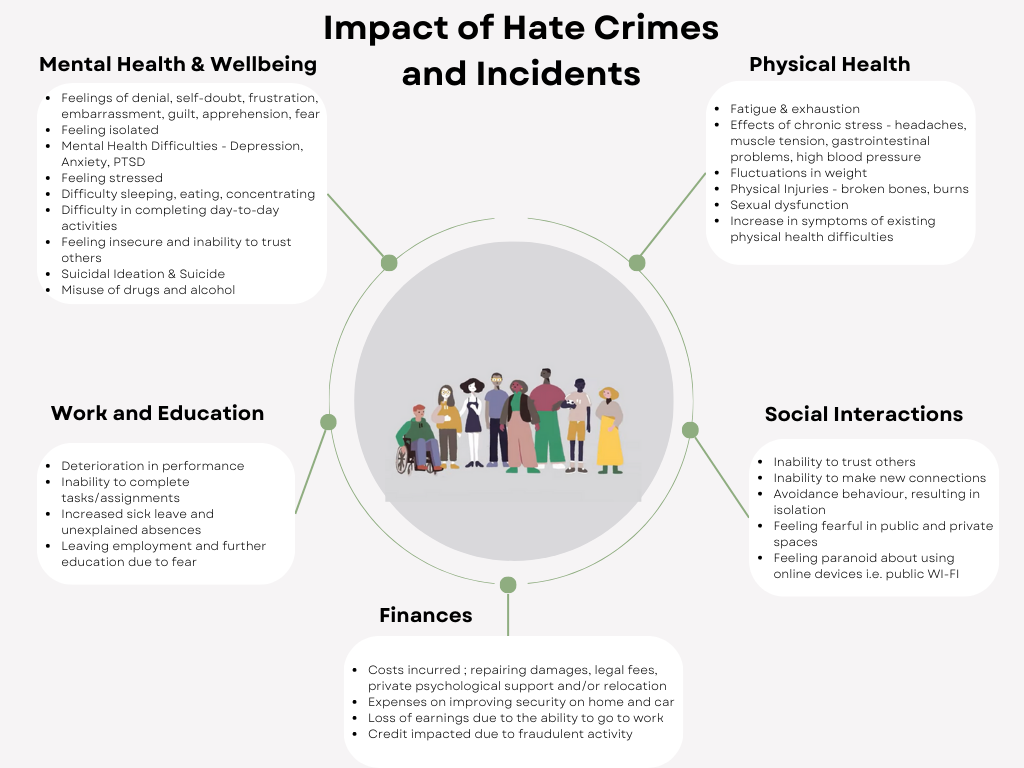
Impact of Hate Crimes and Incidences
What to do if you or someone else has experienced a hate crime?
It is important to note that both hate crimes and hate incidents can take many forms.
Whether you or someone you know has been a victim of a hate crime or hate incident, you can receive support in a way that feels comfortable for you.
If you are in immediate danger, please call 999 straight away.
You can speak to a member of the Standing Together team by making a disclosure on our Report and Support system. A member of the team will contact you initially, and can continue providing support on available safety and reporting options if this is something you wish to pursue.
You can also make a report to the police by contacting 101 (non emergency line), making an online crime report, or attending your local police station.
Victim Support Anyone affected by crime can contact them directly – you don’t need to talk to the police to get Victim Support help.
True Vision offers guidance on reporting hate crime and hate incidents. If you do not wish to talk to anyone in person about the incident or wish to remain anonymous, there is an online form for reporting hate crime; you can report non-crime hate incidents to the police to try and prevent any escalation in seriousness.
A national charity with a free helpline for reporting crime anonymously.
A national project supporting victims of anti-Muslim hate and monitoring anti-Muslim incidents.
Community Security Trust (CST)
A charity protecting British Jews from antisemitism and related threats.
A national charity providing advice and support to members of the LGBT community.
A service providing emotional support, access advocacy and specialist resources and ensure your safety and well-being.
The Speak out Space is an online hub created to educate the communities of Leicester, Leicestershire and Rutland about what hate crimes are and the support available for anyone impacted.
Report Racism GRT is a hate incident reporting site and support service that is run by and for Gypsy, Traveller and Roma communities in the UK by GATE Herts
Southeast and East Asian Centre (SEEAC)
A community organisation run by and for migrants, refugees, and asylum seekers from Southeast and East Asia, as well as people of these heritages living in the UK.
We provide support and advocacy for individuals and communities experiencing challenges related to welfare, immigration, employment, healthcare, racism, mental health, and gender-based violence.
Specialise in helping those with learning disabilities lead fulfilling lives. Call Mencap direct on 0300 333 4444 to find Mencap services near you, or check out their Website for resources and campaigns.
For more information about hate crime, please visit the Leicestershire police information webpage.
The University of Leicester is committed to protecting freedom of speech within the law. This means students, staff and visitors can share and discuss ideas, even where others may disagree.
However, this does not include behaviour that is unlawful, such as harassment, discrimination or abuse.
If you feel you have experienced this, you can disclose it and be heard through our Report and Support tool